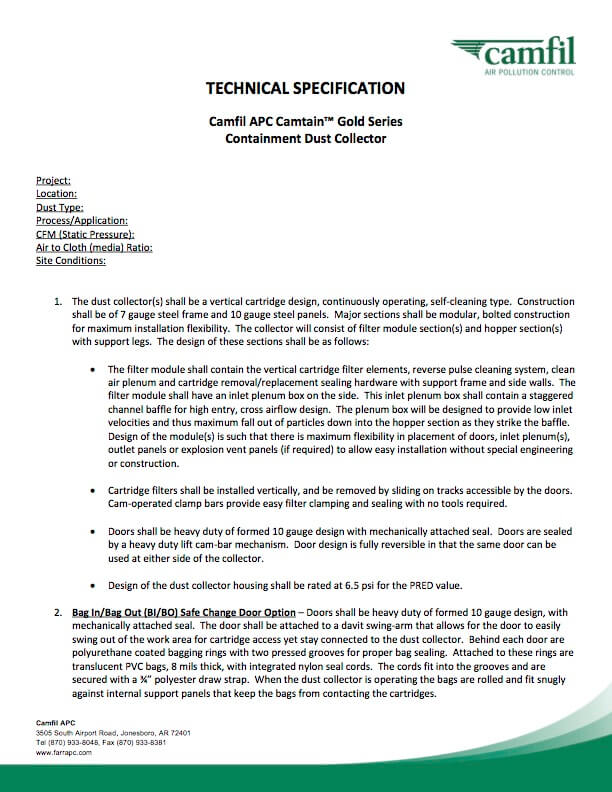
Keeping Dust Out of Non-Manufacturing Spaces (Europe)

High efficiency dust collectors are well known for maintaining cleanliness in industrial manufacturing areas. But offices, control rooms, server rooms and similar spaces in these facilities must also be protected against dust infiltration. Pressurization in combination with cartridge-style dust collection is an effective and sometimes overlooked air-cleaning strategy. This white paper will review: How pressurization works Whether to pressurize your...
How to Save Money, Time and Energy on Dust Collection (Europe)

When it comes to choosing filters for a cartridge dust collector, manufacturing professionals sometimes regard these items as more or less of a commodity. Though the lowest-priced filter might appear to be the best choice, the opposite may be true. It requires a “Total Cost of Ownership” (TCO) evaluation to know for certain. TCO helps you determine what it really...

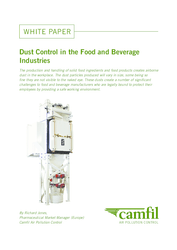
Dust Control in the Food and Beverage Industries (Europe)

The production and handling of solid food ingredients and food products creates airborne dust in the workplace. The dust particles produced will vary in size, some being so fine they are not visible to the naked eye. These dusts create a number of significant challenges to food and beverage manufacturers who are legally bound to protect their employees by providing...

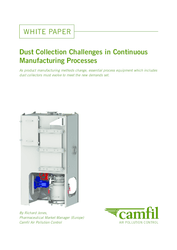
Dust Collection Challenges in Continuous Manufacturing Processes (Manufacturing Chemist, in Europe)

For decades, solid product manufacturing in industries including pharmaceutical and chemical has been based on batch production, whereby a pre-determined weight of ingredients is processed before being discharged as finished product. Continuous manufacturing processes however run on the basis that there is a simultaneous charging and discharging of ingredients and finished product. This change in manufacturing process has been embraced...

Dust Collection Challenges in Continuous Manufacturing Processes (EPM, in Europe)

For decades, solid product manufacturing in industries including pharmaceutical and chemical has been based on batch production, whereby a pre-determined weight of ingredients is processed before being discharged as finished product. Continuous manufacturing processes however run on the basis that there is a simultaneous charging and discharging of ingredients and finished product. This change in manufacturing process has been embraced...