Americas
A filter’s purchase price is only one part of its total cost. Lower-priced filters often provide shorter service life, lower performance and higher operating costs. Over time, savings can disappear, resulting in thousands of dollars in additional annual expenses from more frequent filter replacements, higher energy consumption and increased maintenance.
Consider it the same way you would when buying an oil filter for your car. Would you rather buy a $10 oil filter that lasts one month or one that costs $20 that lasts for a year and helps your car perform better and use fewer gallons of gas each week? In the long run, the higher quality filter delivers greater value despite its higher initial cost.
Why Premium Dust Collector Filters Last Longer and Perform Better
The same principle applies to dust collector filters. Investing in premium filters with the right type of media for your application cuts costs because they last longer, consume less energy and allow your dust collector to operate more efficiently.
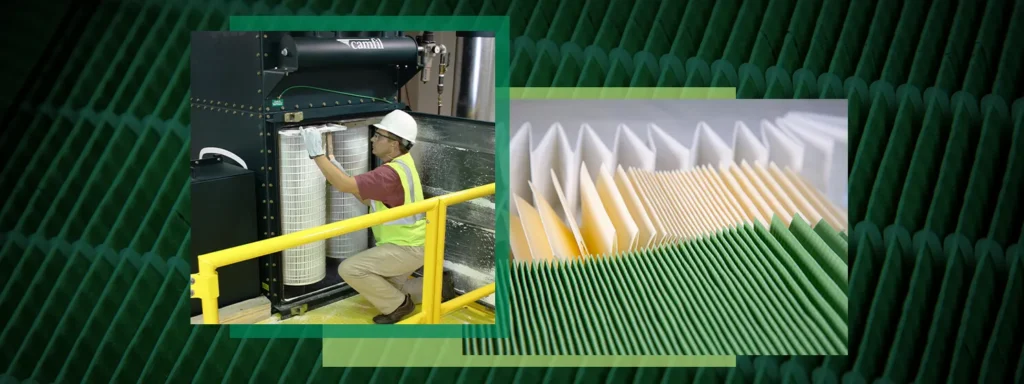
By comparison, low-cost aftermarket filters can fail rapidly—sometimes within weeks. In high-performance dust collectors, inferior filters may not withstand the force of the pulse-cleaning system. The filter media can separate from the end caps, flanges can warp, seals can rupture and cartridges can shift out of position. Beyond creating a mess, failed filters can release collected dust back into the facility, exposing employees, contaminating products and damaging equipment.
Choosing the right replacement filter for your cartridge dust collector can significantly impact both the performance and operating cost of your dust collection system. Premium extended-life cartridge filters reduce change-out frequency, lowering replacement, maintenance and disposal costs. Depending on the application, high-quality cartridge filters can provide years of reliable service between replacements. Failed filters expel the collected dust back into the facility, causing a health risk for employees
Too Much Filter Media Can Be a Problem

OmniPleat retrofit filters provide 30% longer filter life than other filter brands
Some manufacturers increase the amount of media by packing the pleats tightly together so they can advertise more square footage. Unfortunately, much of that additional media provides little or no filtration benefit because airflow cannot effectively reach the inner pleat surfaces. Dust collects along the outer edges, while material trapped between the pleats is difficult for the pulse-cleaning system to remove.
However, when it comes to media, more is not always better. A common misconception is that filters with more media automatically last longer. In reality, the total amount of media is less important than the amount of usable filtration surface available for airflow. This is reflected in the filter’s effective air-to-cloth ratio.
How Open Pleat Design Improves Dust Collector Filter Performance
The result is a filter that loads more quickly, cleans less effectively, and develops higher resistance to airflow. As pressure drop increases, the dust collector must work harder, consuming more compressed air and energy to maintain airflow. Eventually, system efficiency declines, operating costs rise and the filters must be replaced sooner to restore performance. Click here to watch a 1-minute video about the differences in filter pleating technology.
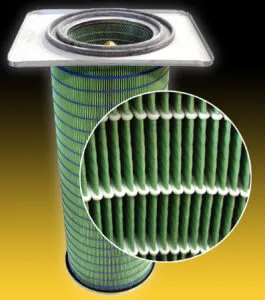
OmniPleat® Pleating Technology Features Open Pleat Design
The most effective cartridge filters are designed with optimized pleat spacing that maximizes usable filtration area, not simply the total amount of media. This design allows dust to be released more effectively during pulse cleaning, resulting in lower pressure drop, longer filter life, and lower overall operating costs.
The key is an open pleat design that keeps pleats evenly spaced so virtually all their filter media remains available for airflow and dust capture. Improved airflow reduces pressure drop and energy consumption, while wide pleat spacing allows the pulse-cleaning system to remove accumulated dust more effectively. The result is more consistent airflow, longer filter life, lower compressed air usage, and reduced replacement maintenance and disposal costs.
Vertical Filter Orientation Supports More Effective Cleaning
Filter orientation also affects cleaning performance. When cartridges are stacked horizontally, dust released from upper filters can fall onto the filters below. Vertically installed cartridges work with gravity, allowing released dust to fall directly into the hopper instead of being redeposited on adjacent filters. This can improve pulse-cleaning effectiveness and extend filter life.
For example, toxic dusts such as hexavalent chromium are known carcinogens. OSHA has established a permissible exposure limit of 5 micrograms (0.005 milligrams) per cubic meter as an 8-hour time-weighted average. Applications involving highly toxic dust may require high-efficiency filter media to help maintain worker exposure below applicable limits.
Camfil OmniPleat premium retrofit filter cartridges are engineered to outperform standard replacement filters and are guaranteed to provide longer service life. They fit most leading dust collector brands and come with a money-back guarantee that they will provide 30% longer filter life than other filter brands.
Depending on the application, filter media may include standard media for nuisance dusts, synthetic media for fibrous dusts, aluminized or carbon-treated media for statically charged dusts, hydro-oleophobic media for high-humidity conditions, and flame-retardant media for combustible dusts.
Click here to watch a 1-minute video showing how pulse cleaning works.
How Pressure Drop Affects Dust Collector Filters
Camfil OmniPleat filters are available with different media to address specific dust types and operating conditions. Choosing the right media is just as important as selecting the right filter design. So, it’s important to understand the characteristics of the dust your process generates.
Different dusts have unique physical and chemical properties that determine the type of filtration required. Particle size, shape, abrasiveness, moisture content, stickiness and whether the dust is combustible or toxic can influence the best filter media for the application.
The dust collector monitors differential pressure—the pressure difference between the clean-air and dirty-air sections of the collector. As dust accumulates, differential pressure rises. When it reaches a preset level, the pulse-cleaning system releases a short, high-velocity burst of compressed air through the cartridge to dislodge the dust so it can fall into the hopper. Typical pulse pressure is approximately 90 to 100 psi, although the correct setting depends on the collector design and manufacturer specifications.
Other applications may require specialized media designed to handle fine particulate, fibrous materials, abrasive dust or oily mist. Selecting the wrong media can lead to premature filter plugging, excessive pressure drops and shorter filter life.
Because dust collector filters are continually pulse cleaned, they last much longer than disposable HVAC filters and may provide up to a year or more of service in some applications. Actual filter life depends on dust loading, operating conditions, filter quality, pleat design and whether the media is appropriate for the dust.
Download our free infographic to identify the best dust collector filter media for your application based on the type of dust your operations produce.
Effects of Differential Pressure and Pressure Drop
As dust collectors move huge volumes of dust-laden air through the system, dust gradually accumulates on the filter cartridges. Clogged filters restrict airflow, which causes the dust collector’s fan to work much harder to keep the airflow high enough to capture the dust particles. This increases the system’s static pressure, or pressure drop, which is measured in inches of water column. Higher pressure drop requires more fan energy, increasing operating costs. For this reason, maintaining a low pressure drop is essential for efficient dust collection performance.
Calculate the Total Cost of Dust Collector Filters
The dust collector continuously monitors differential pressure – the pressure difference between the clean-air and dirty-air section of the collector. As dust accumulates, differential pressure increases. When it reaches a preset level, the pulse-cleaning system releases a short , high-velocity burst of compressed air through the filter cartridge at high velocity to dislodge the dust so it can fall into the hopper.
Most of the dust falls away with pulse-cleaning, but not 100%. That’s why filter cartridges don’t last forever. Over time, fine particles become permanently embedded in the filter media, causing the baseline pressure drop to gradually increase. Eventually, the filters reach the end of their useful life and must be replaced.
However, dust collector filters have a much longer life than disposable HVAC filters, and can last up to a year, despite processing constant high volumes of dust. Filter life is highly dependent on the type of filter used, whether it is a standard-quality or premium-quality filter, and whether the correct media is used for the specific application.
OmniPleat filter technology helps maximize filter life by reducing pressure drop and improving the release of dust and fume during pulse cleaning. By maintaining lower operating resistance, OmniPleat filters require less fan energy to move air through the system, reducing energy consumption while extending the filter service life and lowering operational costs.
Click here to watch a 1-minute video explaining pressure drop.
Understanding the Filter Cost
When choosing a cartridge dust collector filter, look beyond the purchase price. It’s important to calculate the total cost of ownership to make the most economical and energy-efficient choice. Similar to life-cycle costing, total cost of ownership is a step-by-step evaluation of the four main components of filter cost:
- Energy: How much energy does the dust collector consume daily including electrical costs, compressed air usage, and CO2 emissions? How do different filter designs and media affect energy usage?
- Consumables: What dust collector parts require periodic replacement during normal operation? Will certain filter designs and media better protect the collector so that these parts last longer?
- Maintenance and Disposal: What are the labor and downtime costs associated with changing filters? How do the disposal requirements and costs vary for different filter options?
- Long-term filter costs: Don’t forget to factor in the lifespan of each filter option and the costs to purchase replacement filters. Also, consider the cost of transporting and inventorying filters. Will certain filters require less frequent replacement and, therefore, lower replacement cost over the long run?
Only by analyzing all the associated costs and benefits can you determine the true filter cost and achieve significant long-term savings. 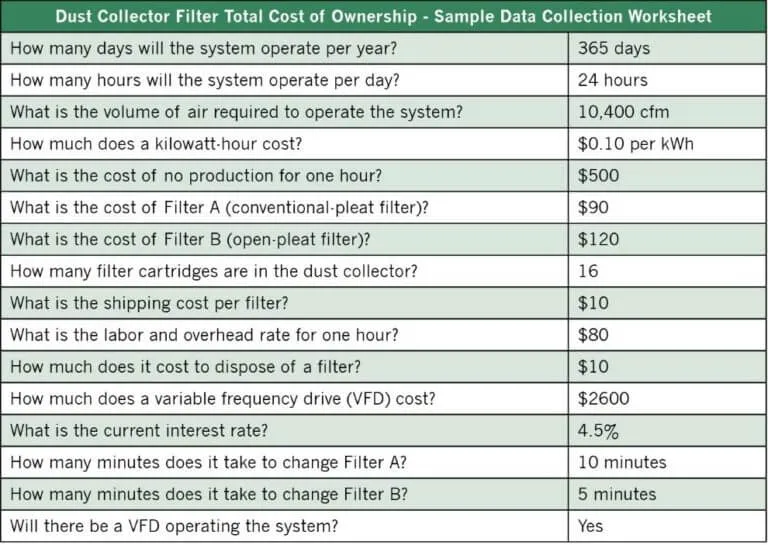
Premium cartridge dust collector filters may cost more upfront, but they usually save you money in the long run. They last longer, help your dust collector work better and lower your operating costs. Less expensive filters may seem like a bargain, but they tend to clog faster, require more frequent replacement, consume more energy, and increase maintenance expenses.
High-quality filters with advanced pleat designs, such as open-pleat technology, allow for better airflow, lower pressure drop, and more effective pulse cleaning, helping filters stay cleaner and perform efficiently for longer.
When you consider the total cost of ownership including energy use, maintenance, replacement frequency, and filter lifespan, premium filters are often the most cost-effective choice.
To learn more about how you can save on dust collector filters over time, download our TCO white paper .
Frequently Asked Questions About Dust Collector Filters
What are dust collector filters?
Dust collector filters are cylindrical, pleated cartridges that capture industrial dust from process air. They are designed to work with pulse-cleaning systems so accumulated dust can be released into the hopper while the collector continues operating.
How do self-cleaning dust collector filters work?
A pulse-cleaning system sends short bursts of compressed air through each cartridge. The pulse flexes the media and releases most of the dust cake so it falls into the hopper. Cleaning can be triggered at timed intervals or when differential pressure reaches a preset level.
How long do dust collector filters last?
Filter life varies by dust loading, media type, pleat design, cleaning settings and operating conditions. Premium filters with the correct media can last up to a year or longer in some applications, while poorly matched or low-quality filters may fail much sooner.
What causes high pressure drop across dust collector filters?
High pressure drop can result from excessive dust loading, embedded fine particles, moisture, oily contaminants, ineffective pulse cleaning, tightly packed pleats or filter media that is not suited to the application.
What type of dust collector filter media is best?
The best media depends on the dust’s particle size, shape, abrasiveness, moisture content, combustibility, toxicity and tendency to carry static charge. Dust testing and application review help identify the safest, longest-lasting option.
Are vertical or horizontal dust collector filters better?
Vertical cartridges generally support more effective pulse cleaning because gravity carries released dust directly into the hopper. In horizontal arrangements, dust from upper filters can fall onto cartridges below and be reintroduced into the filter pack.
How should facilities compare the cost of dust collector filters?
Compare total cost of ownership rather than purchase price alone. Include filter life, fan energy, compressed-air use, maintenance labor, downtime, disposal, shipping and inventory costs.